Series Navigation
7 PartsComplete Event-Driven Architecture & Apache Kafka Blog Series
Series Overview
Introduction to Event-Driven Architecture - Building Your First Kafka Example
A Beginner's Guide
Designing Events - The Heart of Event-Driven Architecture
Poor event design leads to tight coupling, versioning nightmares, and systems that are hard to evolve.
Introduction to Apache Kafka - The Event Streaming Platform
This is where traditional message queues fall short, and where Apache Kafka excels.
Hands-On Kafka - Building Your First Event-Driven Application
In this part, we'll build a complete event-driven e-commerce system using Kafka.
Advanced Kafka Concepts - Mastering Production Kafka
Let's dive deep into advanced concepts that separate hobby projects from production systems.
Advanced Event-Driven Patterns - CQRS, Event Sourcing, and Sagas
Let's explore advanced architectural patterns that leverage events to build sophisticated, scalable applications.
Operating Event-Driven Systems in Production
Now comes the hard part: running it reliably in production
🎉 Complete Event-Driven Architecture & Apache Kafka Blog Series
🤖 Why EDA Matters More Than Ever in the AI Era
Before we explore how Event-Driven Architecture powers modern AI systems, we need to build a solid foundation. Here's why this journey matters:
The AI-EDA Connection You Need to Understand
Artificial Intelligence is transforming every industry, but there's a critical infrastructure challenge that often gets overlooked: AI systems are inherently event-driven. Think about it:
- Real-time ML models need continuous streams of data to make predictions
- AI agents must react to events happening across multiple systems simultaneously
- Training pipelines consume massive event streams from user interactions, sensors, and application logs
- LLM-powered applications orchestrate complex workflows triggered by user requests, API calls, and system events
You can't build production AI systems without understanding how to handle events at scale. Period.
Part 1: The Specialization Revolution Is Here
While the industry races toward ever-larger language models, two of tech's most influential organizations - Nvidia and Gartner - are pointing in a surprising direction: smaller, specialized models will dominate enterprise AI already in 2026/2027.
The New Architecture: Agentic Swarms
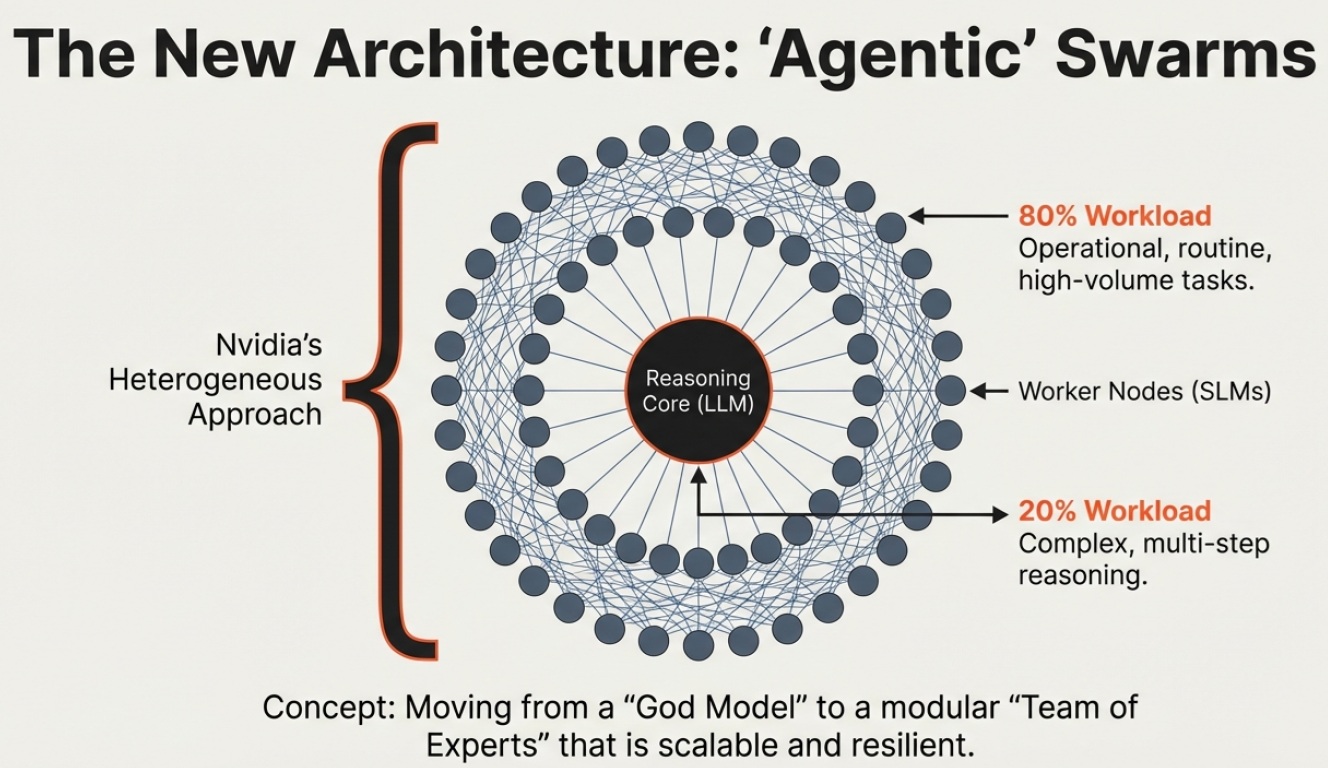
The transition from a "God Model" to a "Team of Experts" (or agentic swarms) represents a fundamental shift in AI architecture, where a single, monolithic Large Language Model (LLM) is replaced by multiple, specialized Small Language Models (SLMs) working in coordination
1. Moving Away from the "God Model"
The "God Model" refers to general-purpose LLMs that attempt to "know everything" but often master nothing in specific business contexts. While powerful, these monolithic models suffer from:
- High latency - Every request waits for a massive model to process
- Massive operational costs - Processing millions of events becomes prohibitively expensive
- Higher hallucination risk - Generic models lack deep context for niche enterprise data
The industry is shifting toward a "specialized is smarter" mantra, recognizing that bigger is not always better for operational tasks.
2. The "Team of Experts" (Agentic Swarms)
In an agentic swarm architecture, organizations deploy a collection of specialized SLMs (typically under 10 billion parameters), each fine-tuned for a narrow, specific task.
Decoupled Specialization: Instead of one brain, each "expert" agent masters a single job—fraud detection, log analysis, logistics optimization, or event classification.
The 80/20 Hybrid Rule: NVIDIA proposes a hybrid model where SLMs handle 80% of routine, operational workloads, leaving large "God Models" reserved only for rare, complex, multi-step reasoning or final synthesis.
Collaborative Intelligence: Gartner predicts that by 2028, these multi-agent systems—where specialized models collaborate to solve a single problem—will become the enterprise standard.
This isn't just another trend forecast to file away. For architects building event-driven systems with Kafka, this shift unlocks something we've long needed: intelligence that lives directly in the data pipeline, not bolted on afterward. Instead of routing events to remote AI services and waiting for responses, specialized models can analyze, enrich, and make decisions on streaming data in real-time-transforming how we build intelligent systems.
The upcoming NVIDIA "Rubin" chip architecture (late 2026) is designed to catalyze this transition by reducing token costs by 90%, making it economically viable to deploy these efficient, specialized models at scale throughout your infrastructure.
These characteristics address core challenges for event-driven systems: handling massive event volumes, meeting tight latency budgets, and keeping the cost of processing millions of events per hour under control.
Why This Matters for Event-Driven Architecture
Nvidia's research shows Small Language Models (SLMs) are:
- 30x cheaper to run than large general-purpose models
- 10x faster in response times
- Deployable on edge devices like standard servers or consumer hardware
Gartner predicts that by 2028:
- Over 60% of enterprise AI models will be domain-specific, not general-purpose
- Multi-agent systems where specialized models collaborate will become standard
- Focus shifts from experimentation to measurable ROI
The Economics of Event Processing at Scale
The cost difference is dramatic: Processing events at scale with large language models is prohibitively expensive, whereas specialized Small Language Models (SLMs) offer significant cost reductions—often 90%+ lower—making them economically viable for high-volume event processing. For real-time data pipelines like Kafka, SLMs can classify and enrich events with ultra-low latency, with fine-tuned models showing substantial performance improvements over general-purpose LLMs while maintaining or exceeding accuracy for specific tasks.
Part 2: The Perfect Match - SLMs + Event-Driven Architecture
Think about the typical challenges in event-driven systems:
Latency: Every millisecond counts when processing payment events, IoT sensor data, or real-time user actions. With 10x faster response times, SLMs can classify, extract, and enrich events in single-digit milliseconds.
Cost at Scale: Processing 1 million events per hour with a large LLM could cost $17.5M annually. The same workload with SLMs: $587K. This 30x reduction makes AI-powered event processing economically viable.
Specialization: Instead of a general model that "knows everything but masters nothing," deploy a fraud detection SLM trained exclusively on transaction patterns, or a log analysis SLM fine-tuned on your specific error signatures. These focused models often outperform larger general models on their specific tasks.
Edge Deployment: Process sensitive events locally without cloud egress, reduce network latency, and meet compliance requirements—all because SLMs run on standard hardware.
Part 3: Multi-Agent Architecture: Kafka Meets Specialized AI
Gartner's prediction of multi-agent systems maps perfectly to Kafka's event-driven paradigm. Here's how it works in practice:
Agentic Swarms in Action: Supply Chain Disruption Response
Imagine a global manufacturer managing complex supply chains with thousands of daily shipments across multiple continents. A single delayed container - stuck at Shanghai port due to weather - can cascade into production halts, missed customer deadlines, and millions in losses.
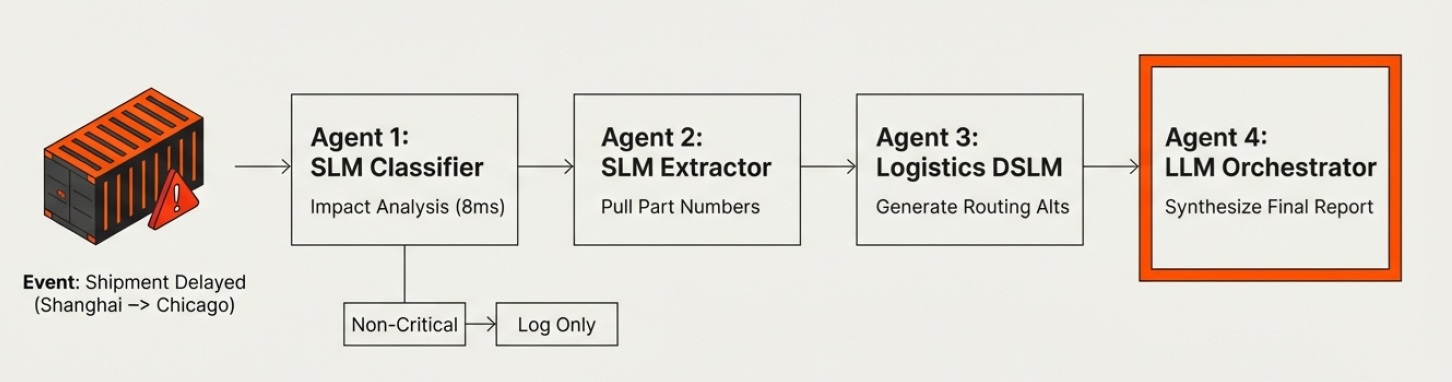
Traditional approaches are reactive: by the time humans identify the problem and coordinate alternatives, it's often too late. Agentic swarms flip this model: the instant a delay event occurs, specialized AI agents analyze impact, extract data, evaluate alternatives, and generate recommendations - completing in 500ms what previously took hours.
The Event Flow:
- Delay notification arrives → shipment from Shanghai to Chicago delayed 5 days
- Agent 1 (SLM Classifier) → Analyzes inventory impact in 8ms → "CRITICAL: affects production line"
- Agent 2 (SLM Extractor) → Pulls structured data: part numbers, suppliers, quantities
- Agent 3 (Logistics DSLM) → Generates alternatives: air freight redirect or alternate supplier, with compliance verification
- Agent 4 (LLM Orchestrator) → Synthesizes comprehensive report for stakeholders
Every delay creates events flowing through Kafka. Here's how specialized SLMs transform this:
KAFKA EVENT FLOW

[Shipment Delay Event]
         ↓
    shipment-events topic
         ↓
┌────────────────────┐
│   Agent 1: SLM     │ ← Classifies impact (8ms, on-premise)
│ Impact Classifier  │   "Is this delay critical?"
└────────┬───────────┘
         ↓
   critical-delays topic
         ↓
    ┌────┴────┐ (parallel processing)
    ↓         ↓
┌─────────┐ ┌──────────────┐
│Agent 2: │ │  Agent 3:    │
│   SLM   │ │    DSLM      │ ← Domain-specific logistics expert
│Extract  │ │  Find Alt    │   Knows maritime law, trade rules
│  Data   │ │   Routes     │
└────┬────┘ └──────┬───────┘
     ↓             ↓
   extracted-data  alternative-routes
     └──────┬──────┘
            ↓
    ┌──────────────┐
    │  Agent 4:    │ ← General LLM for complex reasoning
    │     LLM      │   (only runs once per critical event)
    │  Composer    │
    └──────┬───────┘
           ↓
    stakeholder-responses
           ↓
    [Alerts & Dashboards]
Why This Works:
- Decoupled specialization: Each agent masters one task
- Economic viability: Three cheap SLMs do 90% of work; expensive LLM only for final synthesis
- Real-time performance: Full pipeline completes in under 500ms
- Independent scaling: Bottleneck in classification? Add more Agent 1 instances
- Resilience: If cloud LLM fails, critical work continues at the edge
Why This Series On EDA Comes First
Before diving into AI-specific architectures, you need to master the foundational patterns that make AI systems work:
- Event streaming fundamentals - How do you move millions of events per second reliably?
- Event design principles - What should events contain? How do you version them as AI models evolve?
- Stream processing - How do you transform raw events into features for ML models in real-time?
- Distributed coordination - How do you orchestrate AI workflows across multiple services?
- Production operations - How do you debug when your AI pipeline stops processing events?
What This Means for You
If you're building event-driven systems today, the economics of AI are changing dramatically. What seemed prohibitively expensive six months ago—adding intelligence to every event in your pipeline—is now viable at scale.
The convergence of Small Language Models and event-driven architecture creates unprecedented opportunities:
- Economic viability to process every event, not just high-value ones
- Performance characteristics matching real-time stream processing requirements
- Deployment flexibility for local processing with global orchestration
- Specialization benefits where focused models beat general-purpose giants
The architecture patterns we've explored—embedded SLMs, specialized consumers, multi-agent coordination—will become standard practice by 2026 according to both Nvidia and Gartner.
The question isn't whether this shift will happen. It's whether your organization will be ready.
📚 References: AI Market Predictions & SLM Research
Key sources for the 2026–2027 market shift predictions and SLM performance data:
📚 What You'll Learn
💻 Language: All code examples are in C#. Python implementations coming soon.
🔧 Kafka Version: Confluent Platform 7.5.0 (Kafka 3.5.0) with ZooKeeper for Parts 1-4; Kafka 3.7.0 in KRaft mode for Part 7.
This is your 7-part journey from "What even is an event?" to "I can't believe this actually works in production."
Total Content: 280KB | 10,556 lines | 150+ code examples | 75+ diagrams | 7 complete parts
📖 The 7-Part Series
Part 1: Introduction to Event-Driven Architecture
Why traditional request-response systems fail at scale. The three pillars: Producers, Brokers, Consumers. Complete working e-commerce system. When to (and when NOT to) use EDA.
Part 2: Event Patterns and Design
Three fundamental patterns: Event Notification, Event-Carried State Transfer, Event Sourcing. Schema evolution strategies. Complete ride-sharing app event design workshop.
Part 3: Introduction to Apache Kafka
What Kafka is and why it revolutionized data streaming. Core concepts: Topics, Partitions, Offsets, Consumer Groups. How Kafka achieves incredible performance. Message delivery guarantees.
Part 4: Hands-On Kafka
Docker Compose Kafka setup. Building a full e-commerce order processing system with C# (.NET). Event coordination across multiple services. Testing failure scenarios and event replay.
Part 5: Advanced Kafka Concepts
Exactly-Once Semantics and idempotent producers. Log compaction. Kafka Streams for real-time processing. Schema Registry with Avro. Security: SSL, SASL, ACLs. Multi-datacenter replication.
Part 6: Advanced Event-Driven Patterns
CQRS implementation. Event Sourcing with aggregates and snapshots. Saga Pattern: Choreography vs Orchestration. Outbox and Inbox patterns. Complete e-commerce system combining all patterns.
Part 7: Production Operations
Monitoring with Prometheus, Grafana, OpenTelemetry. Debugging lost events, consumer lag, stuck sagas. Testing strategies. Deployment patterns. Incident response runbooks. Capacity planning.
🎓 Choose Your Learning Path
Beginner Path (4 weeks)
Parts 1→2→3→4 | Outcome: Working event-driven application you can run locally
Intermediate Path (3 weeks)
Parts 1-4 + 5→6 | Outcome: Production-ready implementations with advanced patterns
Advanced Path (2 weeks)
Parts 5→6→7 | Outcome: Complete production operational expertise
Architect Path (2 weeks)
Parts 1-2 + 6→7 | Outcome: Architectural decision-making capability
DevOps/SRE Path (2 weeks)
Parts 3-4 + 5→7 | Outcome: Production operations and scaling expertise
💻 Hands-On Examples
Eight progressive examples mirror your learning journey, from fundamentals to production operations:
Example 1: Fundamentals ⭐ (Beginner)
What it covers: Basic producer/consumer patterns, message flow, Kafka UI exploration
Blog Parts: Parts 1-3
Path: examples/01-fundamentals
Example 2: Core Concepts ⭐⭐ (Intermediate)
What it covers: Event-Carried State Transfer pattern, autonomous services, decoupled communication
Blog Parts: Part 2
Path: examples/02-core-concepts
Example 4: Build E-Commerce ⭐⭐⭐ (Advanced)
What it covers: Complete e-commerce system with 4 microservices, event coordination, error handling
Blog Parts: Part 4
Path: examples/04-build-e-commerce
Example 5: Advanced Kafka ⭐⭐⭐⭐ (Expert)
What it covers: Production Kafka concepts with 6 sub-examples: exactly-once semantics, log compaction, Kafka Streams, Schema Registry, security (SSL/SASL/ACLs), multi-datacenter replication
Blog Parts: Part 5
Path: examples/05-advanced-kafka
Example 6: Event Sourcing ⭐⭐⭐⭐ (Expert)
What it covers: Event sourcing with Kafka, state rebuilding, time travel queries, version tracking
Blog Parts: Part 6
Path: examples/06-event-sourcing
Example 7: Saga Pattern ⭐⭐⭐⭐ (Expert)
What it covers: Saga pattern with Choreography and Orchestration, compensating transactions
Blog Parts: Part 6
Path: examples/06-saga
Example 8: Advanced Monitoring ⭐⭐⭐⭐ (Expert)
What it covers: Full observability stack: Prometheus, Grafana, Jaeger, metrics, tracing, dashboards
Blog Parts: Part 7
Path: examples/07-advanced-monitoring
Quick Start
All examples are ready to run with step-by-step guides:
# Clone the repository
git clone https://github.com/tomakazoo/kafka-event-driven-architecture.git
cd kafka-event-driven-architecture

# Start Kafka infrastructure
./scripts/start-kafka.sh
./scripts/verify-docker.sh

# Run Example 1: Fundamentals
cd examples/01-fundamentals/dotnet
dotnet run --project BasicProducer.csproj
📖 Complete Examples Guide - Detailed setup instructions, troubleshooting, architecture diagrams, and quick reference for all 8 examples
Learning Strategy
Read the blog post → Run the corresponding example → Modify the code → Break things intentionally → Build your own version
🎯 What You'll Achieve
Junior Developers: Explain EDA fundamentals, build basic Kafka apps, contribute to event-driven projects
Mid-Level Developers: Design complete EDA systems, implement CQRS and Event Sourcing, handle distributed transactions
Senior Developers & Architects: Architect complex scalable systems, make informed technology decisions, lead technical discussions
DevOps/SRE Engineers: Operate Kafka clusters in production, monitor and troubleshoot, handle incident response
🚀 What Makes This Different
vs Official Documentation: Progressive learning path, complete working examples, visual diagrams, real-world context
vs Other Tutorials: Production-quality code, complete runnable systems, advanced patterns (CQRS, Sagas), operations included
vs Paid Courses: More comprehensive, higher quality code, better visual explanations, always accessible markdown
📈 Content Statistics
Technologies: C#, Kafka 3.5.0, Docker, Prometheus, Grafana, Jaeger, PostgreSQL, MongoDB, Redis
Patterns: CQRS, Event Sourcing, Sagas, Outbox, Inbox
Diagrams: 20+ architecture, 15+ sequence, 12+ flow charts, 10+ comparisons, 8+ state diagrams
🔗 Additional Resources
Documentation: Apache Kafka | Confluent Platform | Schema Registry
Books: Designing Data-Intensive Applications | Kafka: The Definitive Guide | Building Event-Driven Microservices
🚀 Start Learning
Head to Part 1: Introduction to Event-Driven Architecture and start building your event-driven expertise today!
Each part builds on the previous, taking you from fundamentals to advanced production operations. The code examples work, the diagrams clarify complex concepts, and the explanations ensure you understand not just how, but why.
Happy event streaming! 🎉
This series is the result of years working with Kafka in production environments. It's designed to be your complete guide from beginner to expert in Event-Driven Architecture and Apache Kafka.
Questions about this post?
Send a message and I'll get back to you.